





4G Antenna: Your Turbo for Fast Internet Everywhere
Do you experience poor reception, slow speeds, or constant connection drops with your 4G router? The solution often lies not with the provider, but with signal reception. A 4G antenna is the crucial accessory to utilize the full performance of your mobile internet. It captures the 4G signal from your cell tower, amplifies it, and forwards it directly to your device - for a stable, fast, and reliable connection.
Why 4G Antennas are Essential
Your mobile router has a built-in antenna, but it is often not strong enough to receive a weak signal. Buildings, trees, or topographical conditions massively weaken the signal. An external 4G antenna overcomes these obstacles by receiving the signal directly from outside. The result is higher signal strength, which leads directly to better download and upload speeds as well as lower latency.
4G Indoor Antenna vs. 4G Outdoor Antenna
Depending on your location and local signal strength, there are two main types of 4G antennas.
4G Indoor Antennas
The indoor antenna is the simple and quick solution. You simply place it in the room, ideally near a window or in a spot with good reception. It is ideal if you want to slightly improve the signal within the house without high installation effort.
4G Outdoor Antennas
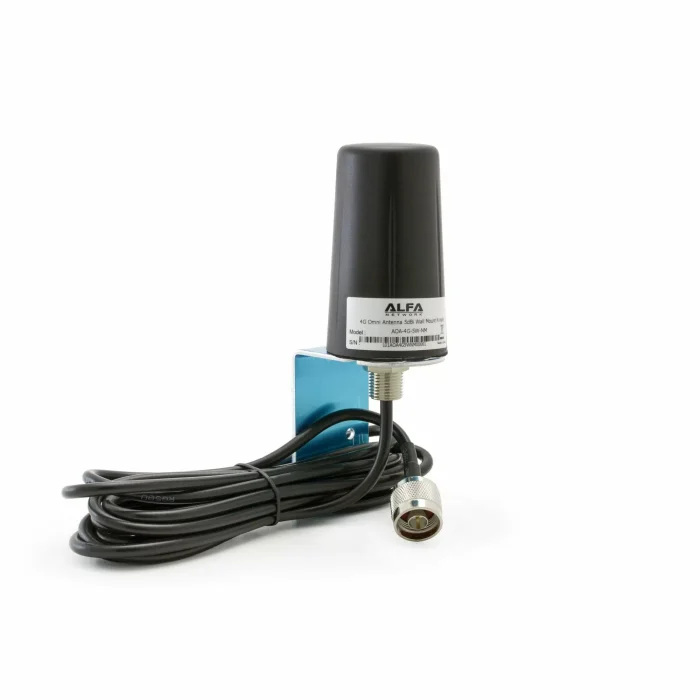
A 4G outdoor antenna is the ultimate solution for a stable and fast connection. It is mounted on an exterior wall, roof, or mast, providing a clear line of sight to the cell tower. Their weatherproof housings are robust and UV-resistant, so they can withstand even extreme weather conditions. They maximize signal reception and are the best choice if you live in rural areas or a building with thick walls.
The IP Protection: Guarantee for Outdoor Reliability
When choosing a 4G outdoor antenna, the IP rating is a decisive quality feature. The abbreviation IP stands for Ingress Protection and indicates how well the housing is protected against the entry of foreign objects (dust) and water.
The first digit indicates protection against dust and foreign objects (e.g., IP6X: complete dust protection).
The second digit indicates protection against water (e.g., IPX7: protection against temporary immersion).
A housing with an IP67 rating, for example, is completely protected against dust and can even be submerged briefly without damage. A high-quality 4G outdoor antenna should have at least an IP rating that reliably protects it against rain, snow, and moisture.
MIMO Technology: The Key to Speed
Most modern 4G devices use MIMO technology (Multiple-Input, Multiple-Output) to increase performance. Instead of using a single data stream, they use multiple antennas to send and receive data simultaneously.
2x2 MIMO: This is the standard for most 4G routers. With two antennas, the speed and efficiency of the connection improve significantly.
4x4 MIMO: If your router supports this advanced technology, you can process double the number of data streams with a 4x4 MIMO antenna. This leads to a massively higher bandwidth and an even more stable connection, which is particularly crucial for demanding applications like HD streaming or video conferencing.
Frequency Ranges for 4G in Europe
In Europe, 4G primarily operates in different frequency ranges:
800 MHz (Band 20): This band has the greatest range and is ideal for rural areas and indoor coverage.
1800 MHz (Band 3) and 2600 MHz (Band 7): These frequencies offer higher capacities and speeds but are more likely to be found in urban and more densely populated areas.
Professional 4G antennas are often multiband antennas covering all important frequency ranges. This ensures your router can always establish the best possible connection to any available cell tower.
Omnidirectional Antenna
An omnidirectional antenna for 4G sends and receives signals evenly in all directions (360°). It is worthwhile if you are looking for a cell tower or if the nearest tower is very close. It is ideal if you cannot or do not want to commit to a specific tower.
Directional Antenna
A directional antenna bundles the 4G signal in a specific direction. It is worthwhile if you have a clear line of sight to a known, distant cell tower and need to amplify a weak signal. It is ideal for achieving maximum signal strength and speed over a long distance but requires precise alignment.
dBi (Antenna Gain)
dBi (Decibels Isotropic) is a unit of measurement indicating how strongly an antenna bundles a signal. The higher the dBi value, the more strongly the signal is bundled in one direction and the greater the range in that direction. Omnidirectional antennas typically have a lower dBi value (e.g., 5-10 dBi), while directional antennas have a high dBi value (e.g., 15 dBi or more) to amplify the signal over long distances.