





Interference factors in WiFi networks
Your WiFi and its Arch-Enemies: What Kills Your Signal!
WiFi is great - as long as nothing gets in the way. The range of your wireless network is hugely dependent on external interference factors. Imagine your WiFi signal as a kind of light beam: the more obstacles in the way, the darker it gets.
The biggest Signal Killers are objects or materials that contain water (trees, rain, snow), metals (reinforced concrete, corrugated metal roofs), or simply have high mass (thick house walls, masonry).
Interference Factor #1: Water - The Microwave Trick
Your WiFi network transmits in the microwave range. Anyone who has put a glass of water in a microwave knows the effect: the water absorbs the microwave energy and heats up.
The same thing happens when your WiFi signal tries to pass through trees or dense bushes.
- Trees and leaves contain a lot of water. This water absorbs the microwaves of your WiFi signal.
- The more water (whether in foliage or from rain) or the more trees in the path of your signal, the more your signal is slowed down and weakened.
The result: The range drops dramatically, and the connection quality suffers. Your data transfer comes in at a snail's pace. 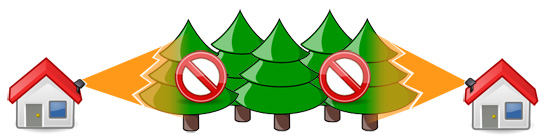
Interference Factor #2: Metal - The Reflector Effect
Metals are the vampires of the WiFi world: they reflect microwaves. Instead of letting the signal pass through, they throw it back or divert it.
The most well-known example is reinforced concrete, which provides stability in modern or large buildings. The steel mats embedded in the concrete form a veritable **Faraday cage** in miniature.
- The denser the steel mesh in the concrete or the more reinforced concrete walls in the path of your WiFi signal, the more the WiFi is reflected and attenuated.
- The signal cannot penetrate cleanly. Reflections often cause what is known as multipath propagation, which can theoretically find detours to the receiver but severely degrades the transmission quality.
Also, corrugated metal roofs, large metal shelves in the garage, or even underfloor heating systems can strongly affect your signal. 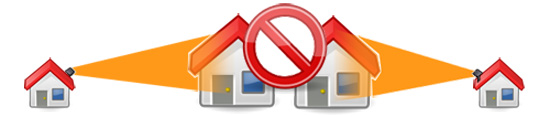
Interference Factor #3: Mass - The Sheer Wall
Besides water and metal, the sheer mass of an obstacle is also a problem. A thick stone wall or a clay wall attenuates the signal simply through its thickness and material density.
Remember the rule of thumb: Every obstacle weakens your WiFi signal. Avoid hiding your router in a corner behind three walls. Position it as open and centrally as possible to maximize range!